Episode 43: Farming in Central South Dakota with Harrell Brothers Farm
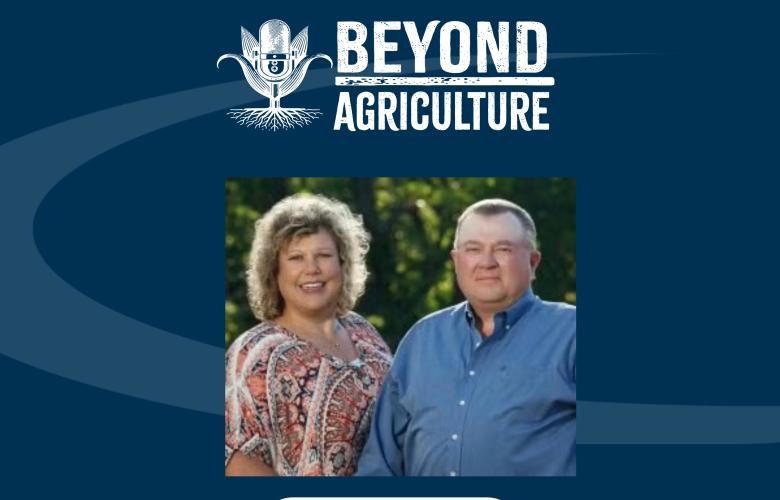
Episode 43 of Beyond Agriculture takes you to the heart of rural America with Lynn and Trish Harrell of Miller, South Dakota. From their deep roots in agriculture to the lessons they’ve learned building a life and legacy in their community, the Harrells share stories of grit, growth, and the values. Whether you’re connected to farming or simply inspired by hardworking families who live with purpose, this conversation will leave you encouraged and proud of the people who make rural America thrive.
- View Transcript
Cassie Johnson (00:02)
Welcome back to Beyond Agriculture, the show where we dig deeper into the people, practices, and progress shaping today's farming world. I'm your host, Cassie Johnson, and today I'm joined by loan officer Ben VanHook. I have some very special guests with us today, my uncle and aunt, who are visiting us all the way from the heart of central South Dakota. Lynn and Trish Harrell are co-owners of Harrell Brothers Farms. From precision technology to soil stewardship to the realities of farming in the Northern Plains, Lynn has decades of hands-on experience and a very clear vision for the future of ag. Lynn, how are you doing today?
Lynn Harrell (00:47)
I'm doing well. Glad to be here.
Cassie Johnson (00:49)
Well, we're glad to have you here. Can you tell us a little bit about yourself, your family, and what brings you to central Kentucky?
Lynn Harrell (00:57)
Well, we're here for the egg equipment show at Louisville on our way. My brother and I started out farming back in 1992. He was a commodities broker, and I ran grain facilities. And we started farming nights and weekends. And in 1999, we went farming full-time. And over the course of that time, we've been in and out of cattle, continued to grow the farm, and then added a retail side to our operation in the seed. We both eventually got married, have children, and now all those children are on their way to college or just graduating high school. We're continuing to grow the operation and make changes where we think we need to make changes.
Cassie Johnson (01:52)
So today I'd like to get a little bit more into your operation because there's a lot of people that listen to this that are from central Kentucky, and that's why I pulled Ben in here today as well, so that way we can have a little insight and questions from a native to this area. But let's focus on a little bit about the landscape of South Dakota and how it differs from what you've been seeing here so far through your trip. But like I said, for the listeners that aren't familiar with central South Dakota, how would you describe the growing conditions?
Lynn Harrell (02:30)
In South Dakota, it's a very challenging environment. We have drastic weather events. We literally can grow zero bushel per acre corn to 200 plus bushel per acre corn, just depending on what mother nature gives us or takes away from us. So it's an extreme environment. I will say the central part of South Dakota is continuing to change. Was very high livestock production in 40, 50 years ago, and that livestock production has become more concentrated and more acres went into farm production, whether it was wheat, corn, beans, sunflowers, millet, milo, grain sorghum, any of that, it has changed. And so there is definitely animal agriculture in South Dakota, but it's in a more concentrated way. And the operations in South Dakota have also become more concentrated. Several families operating the farm versus every farm operated by one family. There are farm families that continue to grow and work together.
Cassie Johnson (03:42)
And what was that that you had mentioned about the number of farmers and the change that you had seen in the actual acreage?
Lynn Harrell (03:51)
The concentration is like what we see in a lot of industries, whether it's IT technology type products to Ag. There used to be an 80/20 rule where 20% operated 80%. I think with the bringing on of AI technology and Just changes in the industry, I think that rule is going to be 9010. I think it's just something that's coming in all industries, and I don't see how it changes.
Cassie Johnson (04:25)
Well, and one of the things that we see a lot around here, Ben, is just the loss of the farmland and the ability for young beginning small farmers to acquire some of that land. You were just talking about there was a farm over by you, a pretty large one. What was the deal with that?
Ben VanHook (04:45)
Yeah. So there was a farm not far from our home place there in Harrison County. It's a little north of where we are here in Lexington. Pretty rural community, a lot of beef cattle, predominantly, with some row crop spread around there as well along the river. Got some pretty good river farms there in Harrison County. But the farm that Cassie was discussing there, it was a guy that had owned the farm for a really long time. A neat story on him. He used to ride a horse to Keeneland up here in Fayette County and was a jockey when he was younger and would ride it home. I don't know how long that trip would take, but it would ride a different horse, his personal horse home every day. That's how he got his start to acquire capital and purchase that farm. But he ran a beef cattle operation there. He only had one child, and that child lived out of the state, actually Alaska. When that secession plan occurred and at his passing, it was left to his remaining child, and it was sold. Now it's listed in 30 and 40 lots for rural housing.
Ben VanHook (06:02)
And that's a challenge that we face here is just urban sprawl and development. It's hard for young farmers like myself and others that we serve here at AG Credit to come up with the capital to compete with someone buying five acres and wanting to build a house or maybe just the job demand that we have here with various industries that bring people to town. So that's some of the challenges we face. Is there development in South Dakota?
Lynn Harrell (06:33)
Yeah, Ben, there is development in South Dakota, and believe it or not, urban sprawl impacts us, but it's in a different way. You take and sell that land by the square foot, then you come out to South Dakota or more rural areas, and you buy that by the acre. And so we see land values shoot up at times that don't make sense. And it's a 1031 tax exchange where they have a certain amount of time to trade out the dollars they took in for their real estate. And so that's where we see a fair amount of impact from urban sprawl. And then I also see companies that go from private to public, and then they take in that money, and then they turn on. And when they take in that money from selling off the company to investors, and they turn on, reinvest that in land. And it don't have to make economic sense from the ag side of things. It just does make sense from them on the tax side of things. And so that has a huge impact on affordability in our area.
Ben VanHook (07:35)
Are there a lot of investment property owners in South Dakota, and do they end up leasing that back to local farmers? How does that work?
Lynn Harrell (07:43)
There's definitely investors in South Dakota. I would say right now when land sells, it's probably 70, 80 % farmer bought. With these elevated values, it's either an investor scenario on a limited basis or A neighbor buying a neighbor or something like that. Now, when land values were lower, the investors were driving the market. But a decade ago, the economics kept the farmer out of the bidding cycle, where now it's both are in.
Ben VanHook (08:15)
Yeah. Another thing we see, too, curious to see if it's a challenge for you all, is I had it written down here, solar. We've had some solar move in to central Kentucky. There's a thousand acres in my home county that is for solar panels now. Is there any of that up your way?
Lynn Harrell (08:36)
I looked into a solar offering where we had these big transmission lines that crossed a section we owned and operated. When I looked into the rules of it and what happened to the land, we didn't do it. I just didn't see the value was high for them. But when they were done, there was nothing left.
Ben VanHook (08:59)
Yeah.
Lynn Harrell (08:59)
In So we bypass the chance.
Trish Harrell (09:04)
And we don't see the solar field so much in South Dakota that you see in other states come in, but we do see the wind tower fields more. Yeah.
Lynn Harrell (09:13)
Then the solar I mean, I can see both sides of that equation, but it's just like the wind. It's too unpredictable. And you need power when you need power. So you got to have more consistent supply. Right. Period.
Ben VanHook (09:27)
Well, I've got mixed emotions because I I personally know some farm families that have done it. With the current grain market, which we can discuss a little bit, the rent from the solar has actually been able to keep their operation afloat and cash flow a little bit. I see the perspective, but I think the long term impact of the solar, like you said, what's going to come of this in 20 years when either the company gets sold or they go out of business, for example, or There's lots of unknowns with taking that adventure.
Lynn Harrell (10:03)
The reclamation costs are where it really comes into play after these solar and wind companies have went through their life cycle. Who's responsible for all that cement and iron that went in the ground and reclaiming the ground back to what it was? And I think that true cost almost makes it unfeasible in my eyes. And so I guess we'll see where the next 30, 40 years takes us on that one.
Ben VanHook (10:30)
All right.
Cassie Johnson (10:30)
We're going to switch gears a little bit here, and we're going to talk a little bit about crops. What crops are the backbone of your operation?
Lynn Harrell (10:39)
In our part of the world, it's corn and beans these days. We used to be very big in spring wheat and winter wheat, corn, beans, sunflowers, a little bit of millet at times. A lot of forage crops. We do have the livestock producers in our area now plant rye, take it for silage hay, and then double crop with hay millet. I try to do two forage crops on the same acre. Otherwise, corn and beans is by far the backbone of the area. Everything's been geared towards that. Sunflowers was a bigger market 10, 15 years ago. Parts of South Dakota are still big with sunflowers. You get more towards the very center pier, Oneida area. Still big flower country. Bird seed market, the D-Hull market. The D-Hull market is what you see in your salad bars, the shelled sunflowers for edible consumption. This is a situation where if tariffs are in place, the sunflower market is a better market in the US. If the tariffs are taken away, Eastern Europe will dominate our market, whether it's coming from Ukraine, Western Russia, Eastern European nations. And so there's a tug of war with that market.
Cassie Johnson (12:02)
So do you see different seed varieties out there? Do you utilize different ones, depending on what your- Yes, we do, Cassie.
Lynn Harrell (12:12)
We run test plots on corn and beans every year. We look at day length of day, length of variety, and the stresses that they can tolerate. We not only need to have drought tolerance in our area, but we need heat tolerance. And there is a difference. A plant needs to be able to shut down in that peak, low humidity, hot period, versus just working very well on limited moisture. And so we look for varieties that can take that, and when the moisture arrives, it can flex to it, flex the yield at that time. And so we look for varieties that have those capabilities plus flex, especially in the corn and the soybeans. There's differences in bean varieties there, too.
Cassie Johnson (12:56)
So I know that you're a steward of the land, and you have a lot of practices implemented in your operation. But how do you find the balance of trying to get those high yields and still being able to sustain the land?
Lynn Harrell (13:12)
We try to no-till as much as possible, where possible. Then we're not always just shooting for the highest yield possible. We shoot for what we call an economical yield. We may start out the year with 140, 50 bushel yield grow on certain zones or fields within a zone or maybe just fields. Then as the year progresses, we see what our moisture situation looks like. We see what the longer term forecast look like, whether they're real accurate, it's hard to say. But then we decide, is it time to do another side dress? Is it time to do a fungicide app? Does that make economic sense to do that? We have a program for every field starting out, and then certain things have to be decided at certain stages of the plant, not necessarily the calendar, but the stage of the plant. And then you make that decision and you live with it the rest of that crop cycle.
Ben VanHook (14:13)
You mentioned fungicide there, and I'm curious because this is a challenge, just the terrain we have here in central Kentucky. The drone technology has made a difference here, being able to do aerial application of fungicide. Do you all do a lot of application with airplanes or cover crops or chemicals?
Lynn Harrell (14:35)
Yeah, we have widespread enough acres that we do use planes for certain things. We've looked into the drone technology and have not found anything that I really wanted to latch onto. The concept is very good because you can spot treat and affect small areas and don't treat the whole field the same. I think that technology needs to advance a little bit. The AI capability that's coming where you can boundary a field and just send a drone out and use multiple drones on the same platform, I think we're not too far away from being able to do that. When you talk about the fungicide side of things, keeping a plant as healthy as possible from the time it goes to the soil to the time it's harvested, that plant health overall is going to get you the best possible outcome with the environmental impacts that may be thrown your way. Sometimes you have to be proactive, and then other times We have to be reactive. We have different formulas for the proactive part. We do certain fungicides at a certain time. Then on the reactive part, I'm going to use a hailstorm. The hailstorm comes through.
Lynn Harrell (15:58)
I want to be out there with something We're getting within 48 to 72 hours, and that's the reactive part. When you see a weather event, haven't had to deal with grasshoppers in a long time, but those type of things require a reactive maneuver.
Trish Harrell (16:14)
There are people in the area that are using the drones and starting to experiment with that. We're so flat that we don't have the terrain issues that you have here. But if you go further west, there are a lot more of that in use for the same reason you're using it. We have such large fields.
Cassie Johnson (16:37)
That's what I was going to bring up. That's what I was going to bring up.
Trish Harrell (16:39)
So what he's talking about, he's right on. I agree 100 %, where there's maybe spot treatments for certain areas of a field, and eventually, and as batteries change, and they can keep power longer for longer distances, that could become a factor. But right now, the airplanes are the best aerial application, the fastest.
Cassie Johnson (17:04)
Because what's the size of your... What's an average size of a field for you guys?
Lynn Harrell (17:10)
The average size is probably 160 to, probably just say 160 acres with several bigger and then more that are smaller depending on waterways, et cetera.
Cassie Johnson (17:24)
So you brought up, we're talking switching gears and going more on the technology side. You've been doing this for a few decades now. You've seen a lot of change in technology. How has using precision egg tools made an impact in your operation?
Lynn Harrell (17:44)
It's made a big impact. But, Cassie, I think you just called me old.
Cassie Johnson (17:49)
Well, listen, last night at supper, okay, Ben, get this. Last night at supper, he's like, How are you doing, kid? And I looked at him and I said, I'm 40 years old. So no offense. But a few decades, we didn't say century, at least. All right.
Lynn Harrell (18:09)
Thank you. Thank you very much. On the changes that we have seen With the jobs my brother and me had, we got to work with farmers that we could see doing it right and maybe not so much doing it right. And so when we left our jobs and went farming full-time, that was in 1999, and we thought if we wanted the equipment we wanted, we needed to do some custom work. And so we started doing some custom work with air seeders. This technology come out where you could Drive straight lines, use GPS. And so we added that. And when we added that, that's when our custom business boomed because nobody wanted those cricket rows in their field anymore. And so they'd hire us to drill what they wanted drilled, and their stuff sat. And then over time, those farmers and ranchers retired out, and we got a shot at renting or buying or whatever the situation was. And that's how we got started. And so from there then, the first time we used, I'll call it sectional control on a corn planter, I can remember finishing the season, and we had a whole pile of 48 bags of corn leftover.
Lynn Harrell (19:29)
And I was thinking, I wonder what happened here because I thought maybe- You forgot off the field or something. Something was not quite right. And no, when you think about point rows on a corn planter, that's how much extra seed we had been planting. Wow. And so that opened up a whole new thing from just auto steer to what's called sectional control. And now we have individual row control. So all them rows shut off at the boundary that you've planted on the field. We see it in the sprayers. It's just continuing to evolve.
Trish Harrell (20:04)
How many monitors are in any given piece of equipment that you're running to control all that technology?
Lynn Harrell (20:11)
Four to seven, depending on which one you're in, it's just, it's what we deal with.
Trish Harrell (20:18)
As you know, I'm in the IT field, and I work with a lot of very well-trained technical folks that have never been exposed to agriculture or farming. And they're all amazed at how much technology we use in our operations and in any given operation these days for those efficiencies that you're talking about.
Ben VanHook (20:41)
Being adaptable with the technology, of course, there's a cost with that, but there's a savings with that as well. Cassie made the comment about your all's focus on conservation and stewardship. I think in general, sometimes farmers get criticized for whether that's fertilizer or chemical usage or seeds. And your comment on the sectional control, it's economical for us to want to use less fertilizer and less seed and be efficient. And that technology is allowing us to do that. And I think it's something we highlight.
Lynn Harrell (21:18)
Yeah. And then the technologies that are available now, it's a way easier to variable rate your population, variable rate your fertilizer. The technology It's coming, it's still being adaptive, but you can target pests and spray just the pest on the fly. That technology will continue to get greater accuracy with time and as AI and the algorithms develop. And so those efficiencies will continue to go up. You talk about things that have changed so much. The idea that a bushel of corn requires 1. 1 units of nitrogen to produce it. There's things out there now through the biological world that you can increase biological life in your soil that makes things available in the soil that maybe weren't available without it. And so the commercial side of that need continues to drop down. And so the more we can become cyclical in what we use to raise that crop, the better, often, the more efficient we are going to be. And I think that road is getting more well-traveled, and there's still a lot to learn, but it's going to get better yet. Right.
Trish Harrell (22:38)
And with that, you have significantly increased the amount of soil testing you do every year to make sure you know what's in the soil, what it needs, and across the entire operation.
Lynn Harrell (22:49)
Yeah, we developed our own zones, and then we soil sample those zones in particular. Then over the last year here, we added our own soil sampler, so then we control it from start to finish. Then between myself and our agronomist, we interpret the results and determine what was taken off a field compared to what the soil tests show us. Then we decide what we're going to shoot for in the next crop.
Ben VanHook (23:16)
Right. I think that's so important right now in today's market. I looked this morning at a local granary Silver Grove is where a lot of my customers deliver corn and soybeans. Corn for a November delivery, 26, was $4. 28, and beans were $10. 79. Farmers are having to budget and really look at the numbers and make sure there's no holes in the operation. The ones that everyone talks about are fertilizer, seed, need chemicals and equipment costs. I'm just interested to hear your perspective on what you all are thinking about and on how to be more efficient going into this coming growing season.
Lynn Harrell (24:00)
One of the things I'm going to hit on right away is equipment costs and how people view them. My brother and I, starting out, literally had nothing, and we use custom work to generate the cash flow to pay for the equipment that we thought we needed to do the job right. Well, when you think about today's equipment costs, and I think people have to really think hard about this, we use a 10-year sunset window, and we try to pay for it in five and use it for 10. And We see a lot of people that try to... They think that at three years or five years, whenever they have to start throwing some repairs at something, it's time to do something different. But today's costs, that window has got to be bigger. I want somebody, maybe even you all to think about this. If true inflation is 2-3% a year and you can maintain ownership of something for 10 years, your salvage value has increased by 25-30% in that 10-year window. So then your hard cost over that decade has decreased by 20 to 30% because of inflation and being able to utilize that piece of equipment that much longer.
Lynn Harrell (25:14)
And that is a rule that we have adhered to until... We've had pickups and things like that that they didn't make the 10-year. Well, they're used up, they're used up. But when you're thinking planners and drills and combines and these high dollar items, you have got to stretch that out to maintain that hard cost lower over a long period of time.
Ben VanHook (25:38)
Yeah, and that's a real deal right there. It shows how much goes into the enterprise and what we have to look at to keep those costs down when you're budgeting going into the growing season. You bet.
Lynn Harrell (25:55)
That's a hard cost. I mean, there's no escaping it. If you want to use You want to do things right, take care of it and shoot for that longevity.
Cassie Johnson (26:07)
So there's a lot of planning like Ben was talking about and preparing, but there's always the unknown. There's always going to be risk. There's always going to be weather. Do you have any insight or could share any of your thoughts on to help people trying to do this farming? How do you work around that unpredictable?
Lynn Harrell (26:32)
When you get smacked, which every farmer, rancher will, you'll get smacked with something. And the biggest thing is that you have to just put your head down, figure out what you're going to need to get through it, and then execute on it. Sometimes you're going to see good things come, and you never see them coming. Bad things come, you never see them coming. But in agriculture, it is a state of constant change. And so you just have to buckle down and focus on what you know to do and what you can do and work through it. I don't know what else to say. It sounds like just pull your boots up and get after it. Well, it is sometimes.
Cassie Johnson (27:19)
And that is true. I mean, sometimes you just got to go for it. But at the same time, that is mentally really challenging. So as a farmer, and we talk about it a lot, there are a lot of mental health concerns with farmers across the country. What do you do? You just go to your wife and she, Trish says, It's all right, Lynn, and she puts your head on her shoulder.
Trish Harrell (27:46)
Sometimes that does happen, right? Sometimes it's, Hey, what's got you buggered up? And we talk about it and we smile and move forward to the next day, right? Yeah.
Lynn Harrell (28:00)
I'm hard core. If you're looking for a lot of sympathy, I'm probably not the man for that.
Trish Harrell (28:06)
Why am I not surprised having known Cathy for four years?
Lynn Harrell (28:11)
I mean, I've had my own challenges in life, and I've had a low period, and I've had a high period. And that low period, you just buckle down and move forward.
Trish Harrell (28:24)
One of his most famous sayings in our family is, don't look for the big win in a short time frame, right? It's what you do every day. And if you can do one % better than the next person or the next competitor, or just make something one % better, set your goals at that. Stop looking at it as if you have to hit 100 % every day, just like watching your son play basketball. You'll miss 100 % shots you never take, but you're not going to make 100 % of every shot you take either.
Lynn Harrell (28:59)
I mean, That is the case. I'm going to go back to the long term side of things. Just think about the cattle feeder, the hog feeder, the egg laying unit, the poultry guy, and the farmer. If you can lower your cost by 1% every year for your farming career, I want you to think about what that is after 30, 40 years. All it takes is that 1%, that little bit of edge, whether it's the ability to source a little differently, maybe a little cheaper, use a little less, to be just as efficient to any aspect of what you're operating. If you're 1% better on the average over the course of your lifetime, you're going to be 30, 40, 50 % better at the end of your lifetime. That's that long term perspective. Call it the steady Eddie, whatever you want to call it.
Cassie Johnson (30:00)
So, Trish, I'm going to pull you in a little bit to this conversation. Let's talk a little bit about the family side and the farming because we got two brothers, two wives, and how many kids?
Trish Harrell (30:15)
So within the partnership, there's five boys. We have two, and the brother and his wife, they have three boys. Both of the spouses, we work outside the farm. So the day-to-day management decisions are handled by the brothers. We are a supporting cast of all of that.
Lynn Harrell (30:42)
We do have a sister with twin boys and a daughter, and the daughter and the boys have been in our operation since day one also. And so there was a told of eight cousins that have worked together from the time they could, I'm going to say, rough 11, 12 years old, whether it was lawn care, equipment care to tractor driving, truck driving, et cetera. It is typical in the farm side where they are exposed to things at a lot younger age than most are in more urban environments. Yup. And so we have a saying that I've had from day one is that I wanted the family to have the opportunity to be in the operation, but not the obligation. And so as these young people are developing and choosing, we hope there's enough there to take over the operation, but we're still in that gray area where they're going to land.
Cassie Johnson (31:37)
What challenges do you see as the farmwife?
Trish Harrell (31:43)
Keeping that family a whole, right? I mean, it is... No one can fight like family, but no one can love like family. That's what you're doing now, right? I think we've done a really good job with a little bit of separation of those duties, even though they work together all the time. We get together for holidays, we support each other the best way we can. But then we give everybody the space they need to just exist and live in their own lives, too, right? There's a balance. Try not to get to wound up about what someone else is doing. That's the secret sauce. You can't worry about what the next family's into on their private time. That's their business. And when you show up to work, you just go to work.
Cassie Johnson (32:29)
Right. Yeah.
Lynn Harrell (32:31)
One of the things that when it comes to farm families, I've seen a fair amount split up, literally two brothers or three brothers, and split and go different directions. And I call it critical mass. And when you have a farm family working together, that critical mass is intangible, invaluable, because you always have a backup. And when you break that apart, that critical mass is no longer an asset. You have pulled back to a point that you may be looked at as the next addition to some other operation. And so it's a tap dance there. And like Trish said there, I mean, nobody fights or loves like family. And you just have to be well aware of some of the strengths and the weaknesses within the operation. And then you try to point people the direction of their strength so you don't exaggerate their weakness. And it don't always work that way, but you have to give people enough room to succeed or fail and then take care of it upon that end.
Trish Harrell (33:48)
I think managing expectations is what you're getting out there. You're managing the expectations and giving people space to be who they are while making sure that everybody's part of that overall goal.
Ben VanHook (34:00)
You all are hitting on your family. I think to be an operation of that size and be a team and work together for a common goal and having a list of those goals is very important. You mentioned your agronomy Who else is part of your team year in and year out that you rely on and use as a resource to keep everything on the rails?
Lynn Harrell (34:27)
I guess my brother and me Our agronomist, we have a very strong bookkeeper in the operation. He actually comes from 40 years of elevator experience, management CEO type. And because of that, those duties were handed off to him that I used to do on nights and weekends. What we do is, I'm going to use our agronomist position. It's her job to give us the best recommendation for the field, for the whatever the situation is. I've had to tell her that we may not always follow that because then we have to put the economic decision to that recommendation. There's times that there's a little tension there, and I call it productive tension. I've been in situations where the best outcome comes from two people that don't agree but can talk about it and land on a situation that maybe neither one's happy. That productive tension is probably to land you at the best decision possible. I've seen it in boardrooms. I've seen it in our operation, maybe in my at-home relationship.
Trish Harrell (35:46)
We have a whole crew, right? We've got farm helpers, some that have been with us many years and some newer to the operation. We have a lot of our young people that that have been through the family, that have come up through the operation that are very important to us.
Lynn Harrell (36:05)
We try to do, I don't know if we just call it teams, but for the spring run, we have a planting crew and an air seeding crew. We have a harvest crew. We have a bin site crew. When we're emptying bins, nobody's allowed to work by themselves. It's always a team there because accidents happen, and we have had one. And So, yeah, the team effect. And between my brother and I, we decide who we're going to put together when. We do our own spraying now also and our own fertilizing. And so that's a team. And sometimes, those team members change. Maybe it was successful or maybe they got tired of it. So we try to adapt to what our employee pool would like to do. Now, sometimes they have to do some things that maybe they don't like to do, but that It's part of agriculture. It's a day-to-day decision-making process. That off time is where we use the shop as a way to maintain some of this equipment to get the age that it has takes good maintenance. And so we try to be proactive with our maintenance instead of reactive. And we all know in farming, that's not always the case.
Lynn Harrell (37:27)
Things happen. And so there again, that starts out with the coffee in the morning. And we have locals that come and go also with that coffee talk. And when those major periods hit, like planting and harvesting, it's just a different environment. It's time to get going.
Cassie Johnson (37:51)
We'll go ahead and get ready to wrap it up here a little bit, but there's still a couple of questions I have for you. What changes do you see that will shape the future of agriculture in the next 10, 20 years?
Lynn Harrell (38:05)
Ai, by far, is going to change. I probably won't even recognize some of the things you do right now, but I want you to think about something. What would keep a person from pulling up to a field with a trailer load of bots? And they're already preloaded with seed, fertilizer, and chemical. And they march off that trailer, they plant that field while you're sleeping, they get back on that trailer, and it's ready to go to the next field. I don't know if that's truly going to happen or not, but I could see with today's technology and the use of boundaries, etc. You could plant one kernel of corn for every square foot, and you put the fertilizer with it at the same time, and the cost effectiveness of that might shock us on what we could do with something like that. Regardless if that truly would happen, but the technology as a whole, you're going to be able to do so many things so much faster and more efficient with technology that I think the future is bright. I just don't know what it really looks like.
Trish Harrell (39:22)
We're already seeing technology changes in equipment. We've been in harvest equipment that will make adjustments on the fly in the field without any manual intervention from the driver. And so that's just taking us steps closer to that autonomous technology that you're talking about.
Lynn Harrell (39:40)
Some people feel that the AI movement is going to replace the human element. It is and it's not, because I think the job description changes. You're still going to need that seed person, that agronomist. You're still going to need a tech person that has to handle that piece of equipment. So, yeah, maybe we don't have the John Deere tractor technician out there, but we have the bot technician out there. I mean, the job descriptions are going to change drastically.
Trish Harrell (40:15)
And there's still an art to the science, right? I mean, science isn't just strictly one set of rules, because whether it's the ecology, the soil, the weather, all of the factors that come into play still require thinking that hasn't yet been achieved, right? And the adjustments, AI is getting closer all the time.
Lynn Harrell (40:38)
The human eye is the best element we have when it tries to... When you're looking at a crop and you're driving down the road, I mean, this is something I'm famous for, is I wander when I'm driving because I'm always looking at everything. And the human eye- Is that why Trish so instantaneously grabs that handle up above her head all the time? It might be. But when you look at a crop after multiple years, multiple environments, you can start to see things happen in a field. It makes you wonder. I'm the guy that will be driving down the field, see something, or driving down the road, see something in a field, and I'll just stop and walk out to it. I want to see what's going on out there. Sometimes it's a disease, sometimes it's a bug. Sometimes I don't know what it is, but it's different in the different degrees of green or yellow or whatever you're looking at. You can see that. The other side of the future is the use of fungal, bacterial. Just throw them into the biological products. There is a lot There are things out there that we have no idea about.
Lynn Harrell (41:47)
And so how do you figure them out? You have to produce them, try them, and see what the results are. And that's something we started out with. It was called the LCO, the Molecule Technology, 20 plus years ago, and we still incorporate it to this day. But it took a while to figure out what molecule at what concentration did the job.
Cassie Johnson (42:09)
So what do you think the long term vision is for Harold Brothers? Because you got the niece, the nephews, the son.
Lynn Harrell (42:20)
At some point, our young people will be running the show and we'll just drop in and see how it's going.
Cassie Johnson (42:29)
Oh, I I call BS on that one. I don't see you just dropping in to see how it's going.
Lynn Harrell (42:37)
No, that's very true. I didn't get very far with that one. Myself, it's been my goal my whole life. From the time I was old enough to sit in a 40/20 with dad in a plow, that's what I wanted to do. And so I will always be around, I hope, and provide guidance. If I'm asked, and maybe volunteer it once in a while and travel.
Cassie Johnson (43:05)
Do you think that... I mean, do you see them... Do you think they'll stick with just crops, or do you think they'll diversify some more?
Lynn Harrell (43:13)
We have went full circle. We were in livestock, a cow-calf to a feed lot to a finishing, and then exited my brother and I. And I could see livestock coming back in because there are just things that happen in farming that you You can utilize on a tough crop scenario, whether you end up with a cornfield that needs to be cut for silage or you have straw that you could utilize or you got some off-quality green that you'd like to feed rather than destroy. There's just things you could do. And that diversity also helps provide a different revenue stream that hopefully offsets when one is not doing so well, maybe the other one is, like the current livestock market.
Cassie Johnson (44:00)
So speaking of the current livestock market, how do you feel about these tariffs?
Lynn Harrell (44:09)
The tariffs as a whole, I don't particularly like the idea of bringing in the foreign beef. But tariffs as a whole level the playing field for us and the rest of the world, because the rest of the world has used our strong dollar against us to provide something at a way cheaper point than what we could do it ourselves. It took our manufacturing off the US soil, and it exposed us to weaknesses that We can't have. We cannot have meds produced somewhere else. We cannot have parts produced somewhere else. We cannot have what we've had. The idea of relying on a foreign entity to provide us with key components of anything we have, whether it's mechanical or health-wise, we just can't have it. I'm going to go back to the Tariffs on livestock. The ability I would like to see any meat come in here be tariffed to a price equal and or greater than what we raise. Whether that will be allowed to stand, I don't know. I think tariffs are a tool to get us to an equal playing field.
Cassie Johnson (45:33)
We have a lot of young and beginning or people that are wanting to start farming, listen to this podcast. So what would be a thought or a piece of advice that you could give them that are wanting to start right now?
Lynn Harrell (45:49)
If agriculture is your goal, it's got to be your only goal, and you have to look at how you're going to get there. I went to out of O-Tech. I got out of Votec. I was involved in an explosion that burned me, and because it burned me, I could not follow through with the lease commitment that I had made because nobody would borrow me any money. So then I went into the working world, worked at night till I was healed. Then I started working on an elevator, and then I basically worked through that elevator till I got to a management position. And so Looking back, that 10 years, I was hard about what happened to me. I didn't like what happened to me, but I didn't give up on my goal. But that 10 year period of working with farmers of all sorts and ranchers of all sorts, gave me a background and understanding that probably allowed me to be here today. Where I'm going to go with this is if it takes the off-farm job, it's not going to be instant. It has to accumulation over time. And so you take that off a farm job and you start to create equity in something, whether it's three, four cows, your house, you create equity in your way of life.
Lynn Harrell (47:16)
And as you create that equity, opportunity will come. And just don't give up.
Trish Harrell (47:23)
Don't give up. But also in every decision we make, we made choices, personal choices, where where you didn't worry about boating on weekends, you didn't worry about recreation, you didn't focus on that because you focused all of your energy and all of your time into going back into that operation, which made us be able to keep growing in those small increments to be able to get to where we are at.
Lynn Harrell (47:52)
The first new pickup I ever bought was 1992, and I did not get rid of it until it was almost $400,000 1,000 miles. I just used it.
Cassie Johnson (48:05)
Just because it's got a little rust on it doesn't mean it don't work, right?
Lynn Harrell (48:08)
No.
Trish Harrell (48:09)
We didn't worry about a new house. We just didn't do things that we couldn't that weren't contributing to the overall goal.
Lynn Harrell (48:19)
Equity is your friend when you want to try and launch something. If you can create something that a banker can look at and know it has access to it, that's what affords you take the risk. And so creating that equity, whether it's a $15,000 in a pickup or five cows these days or whatever it may be, that is your stepping stone.
Ben VanHook (48:45)
I think another thing I want to add to that is I've heard so many stories in my career as a loan officer that just having relationships, whether you're driving down the road and there's a farmer that raking a row and then turn around and bail in a row and you stop and you help him, or you get a big snowstorm event and your next door neighbor is older in age and you wanted to help take care of them and scrape their driveway. It's things like that that make, that It's a relationship that shows your honesty, your integrity, that maybe turns into an opportunity a year, two, three, four, five years down the road that can benefit a young person to acquire that lease or maybe maybe have an opportunity to purchase on that farm or whatever the case may be. I mean, the opportunities like that are pretty neat.
Lynn Harrell (49:38)
Don't burn your bridges. You may not always agree with that neighbor or this neighbor. You may not always agree with this person or that person. But at some point in your life, you may cross that bridge again with that person or that neighbor. I'm going to give you another, for instance, in the '80s, I was very young, but I I've always been the numbers kid. I did the balance sheet, the cash flow, and the income statement for my mom and dad in the '80s. I remember walking across the street to the Production Credit Association, and there was a guy in there that was basically a hatchet man for PCA at that time, which I didn't know that. I was sixth or seventh grade. I don't remember. His name was Jeff Hauke. I just remember sitting across that desk from that guy. I was a snot-nosed kid, probably in his eyes. But when I got done with the numbers, I asked him, I said, How can I pay you 21% or my parents can pay you 21% when we don't make 21%? And I was mad. I was a mad kid. Well, like I talk about life and bridges, we got started through a local bank, and as we grew, we outgrew that local bank.
Lynn Harrell (50:56)
And so I was recommended to go talk to, at this time, it was called FCSA. And so I just called Pierre, South Dakota, and I asked for a loan officer because I wanted to start that relationship. Well, guess who was on the line?
Cassie Johnson (51:11)
No way.
Lynn Harrell (51:12)
A guy named Jeff Hauke. And he asked me, he says, well, you're a Harold from Miller. I said, yeah. He says, well, do you know Max? I said, yeah, he's my dad. And he says, you're that kid. And I never have forgot that because if It was a rather tense situation. I may not have been very old, but I knew enough about numbers, what I was looking at. And it's just odd how life can come full circle. So you just never know the road or the bridge or the crossing you must make.
Cassie Johnson (51:48)
That's right. That's some good words of advice to leave on for today. I want to thank Lynn and Trish Harrell for being on the podcast. It's been an enjoyment for me and a first for me. Ben, thanks for being on here as well.
Ben VanHook (52:03)
My pleasure. Enjoyed it.
Cassie Johnson (52:04)
It was fun, wasn't it? It was. We look forward to having another Beyond Agriculture podcast. For now, if you could be sure to like, subscribe, and share our podcast, and we'll see you next time.